

Lab Grown Diamonds vs Moissanite
When you get right down to it, the lab grown diamonds vs mined debate really boils down to two things: where they come from and what they cost. Mined diamonds are nature’s ancient treasures, formed over billions of years. Lab-grown diamonds are the product of incredible human technology. Even though they are chemically and physically identical, lab-grown diamonds can save you a significant amount of money for the exact same quality.
The Diamond Dilemma: A Quick Comparison
Choosing between a lab-grown and a mined diamond is one of the biggest decisions you'll make when buying jewelry today. On the surface, they’re both brilliant, authentic diamonds. But their journey to the jeweler's case couldn't be more different.
A mined diamond is the result of incredible geological forces, pulled from deep within the Earth after forming over eons. A lab-grown diamond, on the other hand, is born in a highly controlled environment, using sophisticated technology like HPHT or CVD to mimic nature's process in a matter of weeks. This fundamental difference in origin changes everything—from price and availability to the ethical and environmental questions that come with each.
Key Distinctions at a Glance
So, let's break it down. While they share the exact same physical and chemical makeup, their stories are worlds apart. One is a piece of geological history; the other is a marvel of human innovation.
This image really highlights the main differences you’ll find in production time, environmental impact, and price.
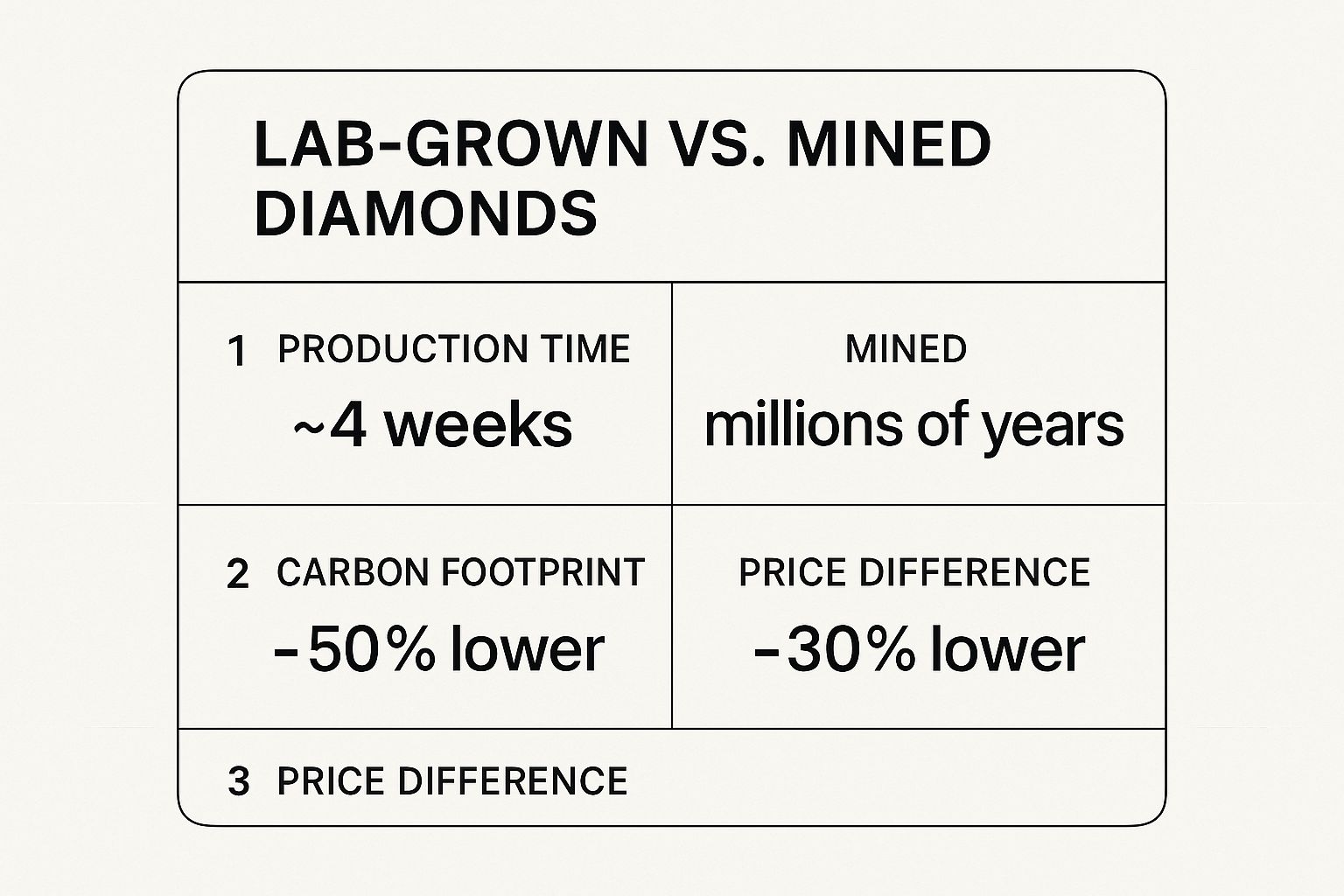
As you can see, the data points to lab-grown diamonds being produced much faster and more affordably, all while leaving a smaller carbon footprint.
Here's the bottom line: You aren't choosing between a "real" and a "fake" diamond. You're simply choosing between two different origins for the very same stone—one created by nature, the other created by science.
To make things even clearer, this table gives you a side-by-side look at what sets them apart.
Lab Grown vs Mined Diamonds At a Glance
Attribute |
Lab Grown Diamonds |
Mined Diamonds |
|---|---|---|
Origin |
Created in a lab using advanced technology |
Formed naturally deep within the Earth |
Chemical Composition |
Identical to mined (pure crystallized carbon) |
Identical to lab grown (pure crystallized carbon) |
Cost |
Typically 30-50% less for comparable quality |
Higher price due to rarity and mining costs |
Ethical Sourcing |
Guaranteed conflict-free and traceable |
Sourcing can be complex; requires certification |
Environmental Impact |
Lower carbon footprint and resource usage |
Higher environmental impact from mining |
Availability |
Supply is controlled and readily available |
Finite supply, dependent on mining discoveries |
This quick snapshot should help you see the primary factors at play. Whether you prioritize tradition, budget, or sustainability, knowing these differences is the first step to making a choice you'll feel great about.
How Are Diamonds Actually Formed?
The real heart of the lab grown diamonds vs mined debate isn't about what they are, but where they come from. At the end of the day, they are identical gemstones, but their origin stories couldn't be more different. One is a product of immense geological time, while the other is born from human ingenuity.
This contrast—nature's slow wonder versus science's controlled process—is everything when it comes to understanding the modern diamond market.
The Ancient Journey of a Mined Diamond
Natural diamonds are true miracles of the Earth. Their story begins incredibly deep, around 100 miles below the surface in the planet's mantle. Here, for 1 to 3 billion years, carbon atoms were subjected to mind-boggling heat and pressure, slowly crystallizing into the diamond structure we know and love.
These ancient gems were then blasted toward the surface by powerful, deep-source volcanic eruptions millions of years ago. The kimberlite pipes these eruptions left behind are where we find diamonds today. It's a process that's entirely natural, incredibly slow, and depends on rare geological events, which has always been the source of their mystique and value.
The Scientific Art of a Lab Grown Diamond
Lab-grown diamonds are made by taking that natural process and recreating it in a high-tech lab. Instead of taking billions of years, it takes just a matter of weeks. There are two main ways this is done: High Pressure/High Temperature (HPHT) and Chemical Vapor Deposition (CVD).
High Pressure/High Temperature (HPHT)
This method directly copies the conditions deep inside the Earth.
-
It starts with a tiny, high-quality diamond "seed" placed in a chamber with pure carbon.
-
The chamber is then heated to around 2,700°F and subjected to immense pressure—over 870,000 pounds per square inch.
-
Under these conditions, the carbon melts and forms a new, larger diamond around the original seed.
Chemical Vapor Deposition (CVD)
The CVD method is more like building a diamond atom by atom.
-
A diamond seed is placed inside a sealed vacuum chamber.
-
The chamber is filled with carbon-rich gases (like methane) and heated to extreme temperatures.
-
Microwave energy breaks down the gas, allowing carbon atoms to fall and bond to the seed, literally growing the diamond layer by layer.
Both HPHT and CVD produce a gemstone that is chemically, physically, and optically identical to one that comes from the ground. The only difference is the origin, which perfectly captures the blend of modern style and sustainable craftsmanship many people are looking for today.
This scientific precision gives us a consistent supply of high-quality, conflict-free diamonds. If you want to dive deeper into our commitment to ethical sourcing, you can learn more about it right here: https://www.moleniajewelry.com/pages/about-the-brand. Whether it's made by nature or by science, the end result is a real diamond through and through.
A Detailed Breakdown of Diamond Costs
Let's talk about the biggest question on everyone's mind: price. When it comes to the lab-grown vs. mined diamond debate, the cost difference is often the single most important factor, and it's a big one. The amazing affordability of lab-grown diamonds doesn't come from a dip in quality. Instead, it’s all about a smarter, more efficient supply chain.
Think about what it takes to get a mined diamond from deep within the earth to a jeweler's display case. The journey is incredibly long and expensive. It involves massive costs for exploration, geological surveys, heavy equipment, enormous operational setups, and a huge workforce. Every single step adds another layer of cost, which ultimately gets passed on to the final price tag.
Lab-grown diamonds, on the other hand, have a much shorter and more predictable path. The process is driven by technology in a controlled environment, which completely removes the guesswork and extreme expenses of mining. That efficiency is what makes them so much more accessible to you.
Real-World Price Comparison
Let’s put this into perspective. Say you’re shopping for a high-quality, 1-carat mined diamond with excellent cut, color, and clarity. With the very same budget, you could easily find a lab-grown diamond that's substantially larger—we're talking 1.5 or even 2.0 carats—with identical quality grades.
This value is a total game-changer. It means you don't have to choose between the size you want and the quality you deserve just to stick to a budget. You can get the stunning look you've been dreaming of without the hefty premium of a mined stone.
This price difference lets you put your money where it counts: into the visible beauty and sparkle of the diamond itself. No matter which type of stone you choose, keeping it brilliant is essential. Our comprehensive care guide can show you how to keep your jewelry looking brand new.
Pricing Trends and Future Value
The cost gap between lab-grown and mined diamonds has widened significantly over the last few years, mostly thanks to huge leaps in technology. It’s a perfect illustration of how much lab-grown diamonds have shaken up the traditional market.
Back in 2018, a lab-grown diamond was about 20% cheaper than a similar mined one. Fast forward to today, and thanks to better synthesis methods and scaled-up production, that gap is massive. By 2024, lab-grown diamonds often sell for 80% to 90% less than their natural counterparts. It's an incredible drop.
To make luxury even more attainable, some jewelers are now offering lab-grown diamonds for as little as $119 for a 0.5-carat stone. This shift has completely redefined what's possible for buyers.
Quality, Sparkle, and Durability: Is There a Difference?
Let’s get straight to the point: when it comes to quality, you can’t tell a lab-grown diamond from a mined one just by looking at it. Even a trained gemologist would need sophisticated lab equipment to spot the difference.
Why? Because they are the same thing. Both are pure, crystallized carbon. Both hit a perfect 10 on the Mohs hardness scale, making them the toughest natural substance on Earth. This exceptional durability is why either type is perfect for an heirloom you want to last forever. The only real distinction lies in their origin story, and that’s something you can only discover with specialized scientific tools.
Graded by the Same Unwavering Standards
Every diamond, no matter its origin, is judged by the same universal benchmark: the 4 Cs. That’s Cut, Color, Clarity, and Carat.
This is critical to understand. Reputable gemological labs like the Gemological Institute of America (GIA) and the International Gemological Institute (IGI) use the exact same strict criteria to grade both lab-created and mined diamonds. A VVS1 clarity grade on a lab diamond certificate means the exact same thing as a VVS1 on a mined diamond certificate. Quality is a property of the stone itself, not how it was formed.
The Bottom Line: You are not compromising on quality by choosing a lab-grown diamond. You’re getting a real diamond, backed by the same independent certification that guarantees its brilliance, purity, and strength.
Interestingly, the controlled environment of a lab can make it easier to produce diamonds with fewer internal flaws (called inclusions) and better color. This means high-clarity and high-color lab diamonds are often more readily available than their mined equivalents.
Identical Brilliance and Heirloom Quality
What gives a diamond its breathtaking sparkle? It all comes down to how it plays with light—its brilliance and fire. These stunning visual effects are determined entirely by the diamond's cut, not its origin. A masterfully cut lab diamond will shine with the same fiery intensity as a perfectly cut mined diamond.
Because they share the same rock-solid durability, you can be completely confident that a lab-grown diamond engagement ring will stand the test of time. It will last for generations, just like a mined stone, and requires the exact same care to maintain its beauty. When you're making your choice, you can set any worries about quality aside. It’s simply not part of the equation.
Weighing the Ethical and Environmental Sides
For a growing number of people, where a diamond comes from is just as important as how it looks. When you put lab-grown diamonds vs. mined ones side-by-side, you're not just comparing stones; you're comparing two completely different origin stories with vastly different impacts on the planet and its people.
Let's be blunt: traditional diamond mining is tough on the environment. It involves moving immense amounts of earth, which can scar landscapes, disrupt local ecosystems, and consume a great deal of water and energy. The process often leads to soil erosion, deforestation, and habitat destruction, leaving a long-lasting environmental legacy.
Lab-grown diamonds, on the other hand, are created inside a highly controlled environment. Think of it as replicating nature's process but without the need for massive excavation. This inherently means a much smaller environmental footprint, making it a more resource-friendly choice from the start.
The Human Cost of Mining
Beyond the land itself, there’s the human element to consider. The diamond industry has a troubled history with "conflict diamonds" (or "blood diamonds")—gems mined in war zones and sold to fund violence. While initiatives like the Kimberley Process Certification Scheme aim to stop this, loopholes and traceability issues mean it's not a perfect system.
The concerns don't stop there. Labor practices in some mining regions have been criticized for unsafe conditions and unfair wages. For many shoppers, the thought of their diamond being tied to any form of exploitation is a deal-breaker.
Choosing a lab-grown diamond offers a straightforward solution to these ethical dilemmas. Because they are created in a controlled environment, their origin is fully transparent and guaranteed 100% conflict-free.
This level of certainty gives you peace of mind, letting you celebrate your special moments without a shadow of a doubt. The demand for ethically sourced gems like diamonds and moissanite is on the rise, and you can learn more about these brilliant alternatives in our guide to moissanite.
The Modern Choice for Conscious Buyers
This shift toward more mindful purchasing is really being led by younger generations who are reshaping the jewelry industry. As of 2025, over 70% of millennial buyers are choosing lab-grown diamonds. It's a decision driven by both their attractive price point and their alignment with modern values.
The environmental data really backs this up. To get just a single carat from a mine, workers may have to move around 250 tonnes of earth. In stark contrast, creating a lab-grown diamond uses about 60% less energy and generates a carbon footprint that is over 50% smaller. It's a measurably greener option.
Ultimately, when you compare lab grown diamonds vs. mined on ethics and sustainability, the lab-created gem holds a clear advantage. It gives you a way to own a stunning, genuine diamond without the baggage of environmental damage or human cost, making it the responsible choice for today's world.
How to Make the Right Choice for You
Choosing between a lab-grown and a mined diamond is a really personal decision. Forget about simple pro/con lists—the right answer comes down to what you truly value. There's no single "best" diamond, only the one that feels right for your budget, your beliefs, and your unique story.
To figure out your path in the lab grown diamonds vs mined debate, start with what's most important to you. Is your goal to get the biggest, most brilliant stone you can afford? Or is the magic for you in the billion-year history and rarity of a gem pulled from the Earth?
Guidance for Different Priorities
If you want to maximize your budget, a lab-grown diamond is the clear winner. The cost savings are significant, meaning you can afford a larger carat weight or a much higher grade in cut, color, and clarity than you could with a mined diamond for the same price. It's all about getting more sparkle for your money.
On the other hand, if you're drawn to tradition and the romance of natural creation, a mined diamond might speak to your heart. For many people, the sentimental value is deeply connected to its ancient geological journey. It's a tangible piece of Earth's history, and that's a story you can't replicate in a lab.
Key Insight: Try not to think of an engagement ring as a financial investment. While it’s true that mined diamonds have historically held more of their value, both types of diamonds resell for just a fraction of what you paid. The real worth of your ring is what it means to you, not its performance on the market.
The lab-grown diamond market is booming. Between 2020 and 2025, the industry was expected to grow by over 7% each year, with prices dropping to almost half that of similar mined diamonds. You can discover more insights about these market trends to see just how quickly they've gained popularity.
Ultimately, this choice also says something about your values on sustainability and sourcing. If you're open to other beautiful and ethical options, you might love exploring our stunning collection of moissanite jewelry, which provides another path to conscious luxury. By carefully weighing what matters most—whether it's price, tradition, or ethics—you can feel confident choosing the stone that perfectly tells your love story.
Your Diamond Questions, Answered
As you get closer to making a decision, a few specific questions usually pop up. It's completely normal. Getting clear, honest answers is the best way to feel great about whichever diamond you choose. Let's tackle some of the most common ones I hear.
Are Lab Grown Diamonds Actually Real Diamonds?
Yes, they absolutely are. A lab-grown diamond is 100% a real diamond. It shares the exact same chemical, physical, and optical properties as a diamond that comes from the earth.
Think of it this way: they're both made of pure, crystallized carbon. The only thing that separates them is their origin story—one was formed in a state-of-the-art lab, and the other was dug from a mine.
A question I get all the time is, "Will it pass a diamond tester?" The answer is a definite yes. Those standard testers are designed to check for thermal conductivity, and since a lab diamond is chemically identical to a mined one, it passes every time.
A lab-grown diamond isn't a look-alike like moissanite or cubic zirconia. It's the real deal, through and through. It has the same incredible hardness and brilliant sparkle, making it a perfect choice for jewelry you want to last a lifetime.
Do Lab Grown Diamonds Hold Their Value?
This is a big one. The resale market for lab-grown diamonds is still finding its footing, and right now, their resale value is lower than that of mined diamonds. But it's crucial to put this in perspective: an engagement ring is an emotional purchase, not a financial one.
The truth is, both lab-grown and mined diamonds resell for a lot less than what you originally paid at retail. So, if you're thinking of it as a long-term investment, you might be missing the point. The real value is in the happiness and meaning the ring brings you every day.
How Can I Be Sure My Diamond Is Ethically Sourced?
This is where the two types of diamonds really show their differences, and each offers a clear path to getting that peace of mind.
-
Lab-Grown Diamonds: These are, by their very nature, conflict-free. Since they are grown in a controlled, scientific setting, you get complete transparency. Their origin is fully traceable, which sidesteps any ethical concerns tied to mining.
-
Mined Diamonds: For mined stones, your best bet is to look for diamonds certified under the Kimberley Process. If you want even stronger assurance, work with jewelers who can trace a diamond back to its specific mine or at least its country of origin.
If you have more questions or want to dive deeper into other topics, please check out our detailed FAQ page. We've put together a ton of information to help you make a choice that feels right for you.


