

Is a Moissanite Diamond a Real Diamond?
Let's clear this up right away: No, a moissanite is not a real diamond. While they might look almost identical to the naked eye, they are two completely different gemstones, each with its own unique story and makeup.
Think of it like this: a diamond is pure carbon, and moissanite is silicon carbide. So, while moissanite is absolutely a real gemstone, it's simply not a diamond.
What Really Separates Moissanite From Diamond
To get to the heart of the matter, you have to look at what these stones are made of. Diamonds are famously composed of pure carbon, created under immense pressure deep inside the Earth over billions of years.
Moissanite, on the other hand, is made from silicon carbide. This compound is incredibly rare in its natural form—it was first found in a meteorite crater back in 1893 by Dr. Henri Moissan. It's literally born from the stars.
Because their chemical recipes are different, their characteristics are too. For instance, a diamond is the king of hardness, hitting a perfect 10 on the Mohs scale. Moissanite isn't far behind, though, ranking at an impressive 9.25. This makes it incredibly tough and a fantastic choice for everyday jewelry, like the beautiful Molenia product pieces available.
The key thing to remember is that moissanite isn't a "fake" diamond. It's a legitimate gemstone with its own amazing qualities, including a durability that's hard to beat and a fire that can even outshine a diamond's.
To make these differences easier to see, here’s a quick side-by-side comparison.
Moissanite vs. Diamond at a Glance
| Attribute | Moissanite | Diamond |
|---|---|---|
| Composition | Silicon Carbide (SiC) | Pure Carbon (C) |
| Hardness (Mohs) | 9.25 | 10 |
| Origin | Lab-created (natural is rare) | Earth-mined or lab-created |
| Brilliance (Fire) | More colorful, rainbow-like | White light, "icy" sparkle |
| Price | Significantly more affordable | Premium price point |
This table shows that while both are brilliant and durable, they are fundamentally different materials with distinct price points and visual effects.
This visual guide helps break down what makes moissanite so special.
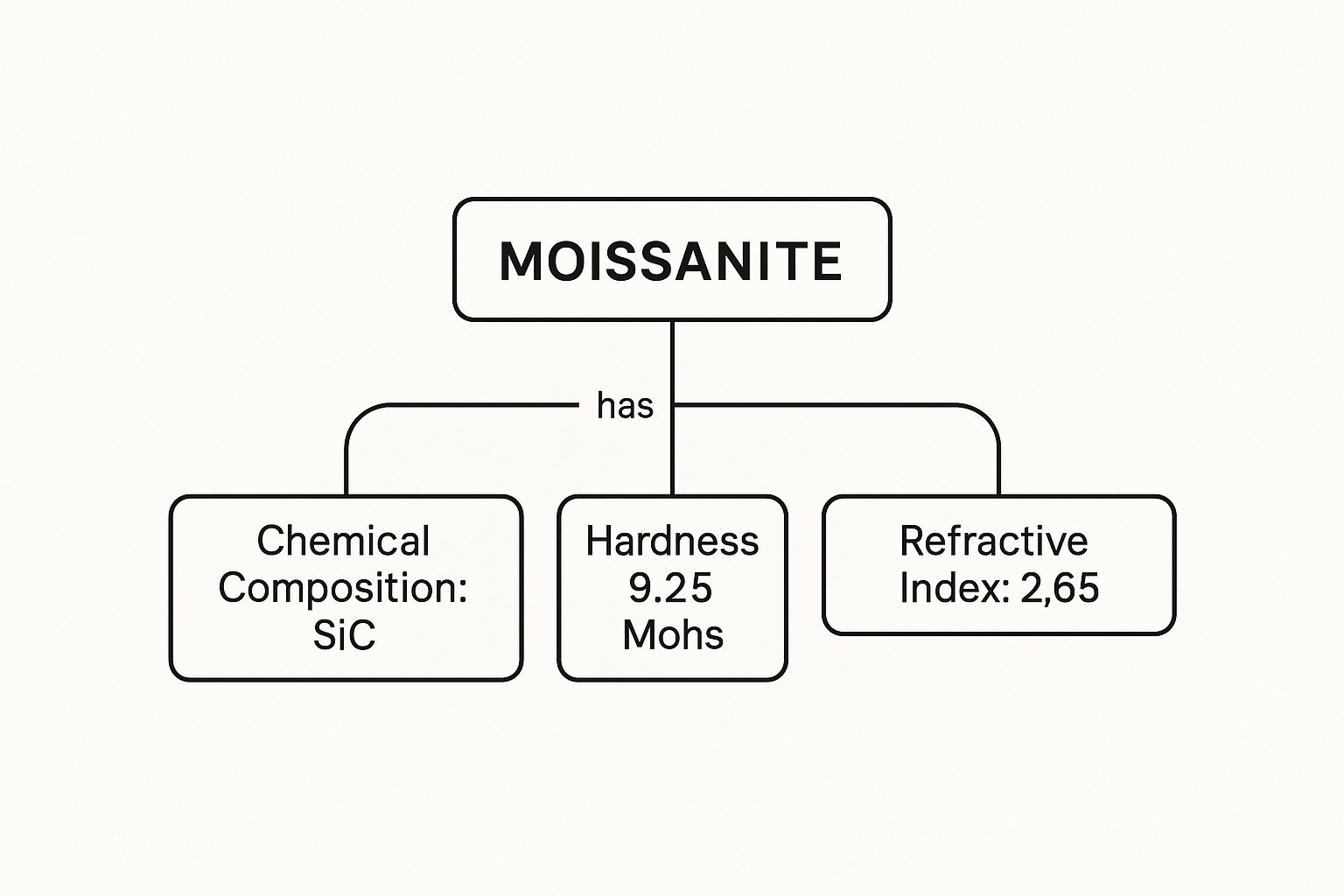
As you can see, it's the silicon carbide composition that gives moissanite its incredible hardness and a refractive index that creates that stunning, fiery sparkle. These are the scientific reasons it stands out as a world-class gemstone in its own right.
Understanding Moissanite: A Gemstone Born From The Stars
To get to the bottom of the question, "is moissanite a real diamond?" we need to look up—way up. The story of moissanite isn't of this earth; it literally starts in the cosmos.
It all began back in 1893 when a French chemist, Dr. Henri Moissan, was sifting through the remnants of a meteorite crater in Arizona. He found these tiny, brilliant crystals and, at first glance, thought he’d struck it rich with diamonds.
It turns out, he had discovered something entirely new. This "gemstone from the stars" was naturally occurring silicon carbide, a compound so incredibly rare on our planet that finding it in nature is next to impossible. For that reason, the gorgeous moissanite you see in jewelry today isn't mined from star-fallen craters—it's meticulously grown in a lab.
From Cosmic Dust to Modern Gem
This is where the distinction becomes crystal clear. A diamond is made of one thing: pure, crystallized carbon. Moissanite, on the other hand, is silicon carbide (SiC). It's simply a different mineral with its own unique properties. Think of it like baking a cake versus a cookie; both are delicious desserts, but they follow completely different recipes.
Moissanite isn't a "fake" or "imitation" diamond. It's a legitimate and stunning gemstone in its own right, with a unique chemical makeup and a modern origin story.
This lab-grown nature is what makes moissanite so accessible and appealing. The process shares some similarities with how lab-grown diamonds are produced, even though the ingredients are different. For a deeper dive into that, check out our guide on lab-grown diamonds vs. mined diamonds.
Because it's created in a controlled environment, you get a consistently beautiful and ethically sourced stone every time, which is a huge part of why it has become such a popular choice.
Comparing The Sparkle: Fire vs. Brilliance
So, what’s the secret behind the mesmerizing glitter of moissanite and diamonds? It all comes down to two kinds of sparkle: brilliance and fire. Getting a feel for what makes them different is the key to figuring out which stone truly speaks to you.
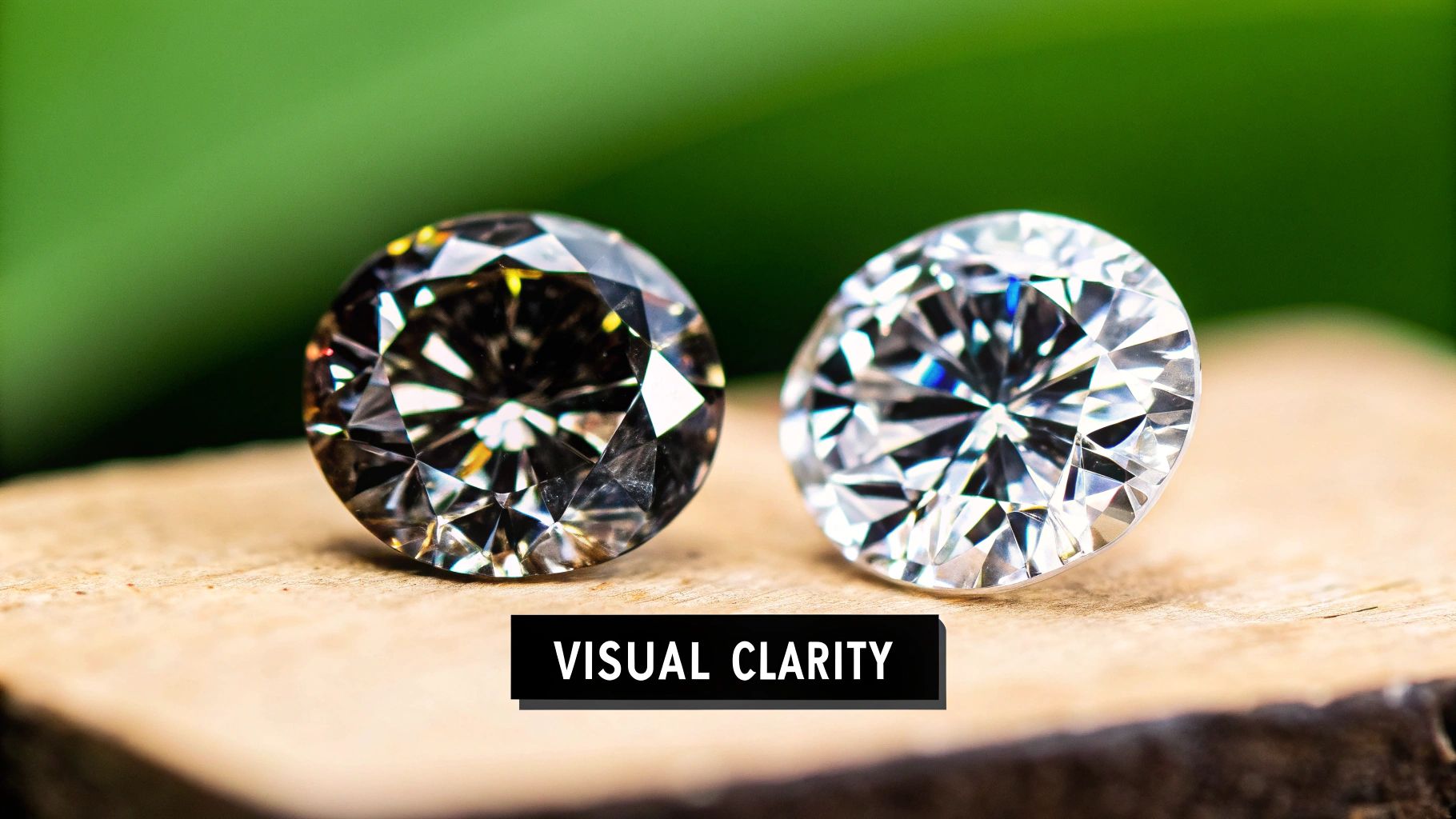
Brilliance is all about how a stone handles white light. Think of it as that bright, icy, and crisp sparkle that shoots back at your eye—it’s the classic look that made diamonds legendary.
Fire, on the other hand, is the explosion of rainbow-colored flashes you see when the stone moves. This is where moissanite doesn't just shine; it puts on a full-blown light show.
A Fiery Disco Ball vs. Classic Ice
The best way to picture moissanite's sparkle is to think of a disco ball. It catches the light and throws a dazzling spectrum of rainbow colors across the room. This intense, fiery personality is what people fall in love with. It's dramatic, eye-catching, and utterly captivating.
To get technical for a moment, this effect is measured by a stone's "dispersion." Moissanite has a dispersion value of 0.104, which is more than double a diamond's 0.044. That’s why its rainbow flashes are so much more pronounced.
Diamonds have a more understated fire, offering a balanced mix of white brilliance and colorful flashes. The look is often described as elegant and crisp, rather than wildly colorful.
It's important to remember that neither type of sparkle is "better" than the other. It really just comes down to what you love. Do you want a show-stopping rainbow display or a sophisticated, classic shine?
The choice often hinges on this very personal preference. To dig deeper into this, our guide on moissanite vs. diamond sparkle breaks it down even further.
How Moissanite's Durability Compares to Diamond
https://www.youtube.com/embed/9AaEs6HAVmE
When you’re choosing a stone for an engagement ring or any piece you’ll wear every day, you need to know it can handle real life. Durability isn't just a nice-to-have; it's essential. Both moissanite and diamond are serious heavyweights in the durability department, but there are some key differences.
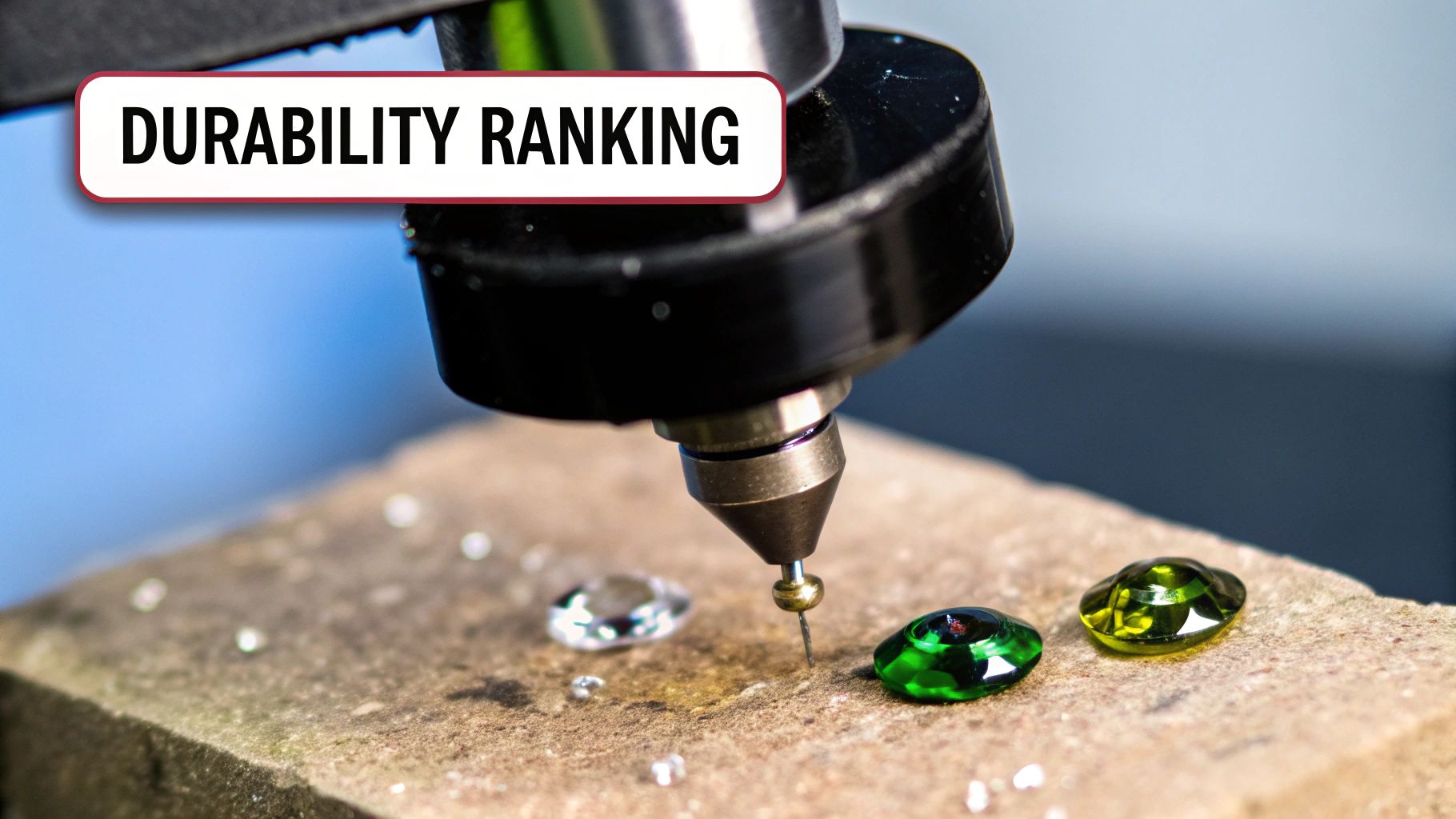
We measure a gem's toughness using the Mohs scale of hardness, which is basically a fancy "who scratches who" test. A diamond, as you probably know, sits at the very top with a perfect 10. It’s the hardest natural material we know of, period.
How Moissanite Measures Up
So, how does moissanite stack up? It scores a very impressive 9.25 on the Mohs scale. That makes it one of the toughest materials on the planet and the second-hardest gemstone you’ll find in jewelry, right behind diamond.
Practically speaking, this means your moissanite is incredibly resistant to getting scratched or scuffed during your day-to-day. You can wear it with total confidence, knowing it's built to last.
This incredible resilience makes moissanite a smart and reliable choice for jewelry meant to be treasured for a lifetime. With just a little bit of upkeep, it will stay just as beautiful as the day you got it. To learn more, check out our guide on how to clean moissanite jewelry at home.
Why Modern Couples Are Choosing Moissanite
It's impossible to ignore moissanite's growing popularity, and it's far more than just a passing trend. We're seeing a real shift in how couples think about and shop for meaningful jewelry. A huge part of this comes down to ethics.
Because every moissanite is created in a lab, you know it's 100% conflict-free. There's no mining, which means it’s also a much more environmentally friendly choice. For many people today, those guarantees are non-negotiable.
Of course, the price point is also a major draw. Moissanite gives you a brilliant, high-quality gemstone for a fraction of what you'd pay for a diamond of the same size and quality. This means couples can get that gorgeous, eye-catching ring they've dreamed of without blowing their budget or compromising their values.
The Smart, Ethical Choice
Ultimately, the decision to go with moissanite is a perfect blend of practicality and principle. It directly answers the call from a new generation of buyers who want gemstones that are both sustainable and ethically sourced.
This isn't just a feeling; the numbers back it up. The global moissanite market is expected to grow at a compound annual growth rate of 8.00% between 2024 and 2031. This kind of growth is a clear signal that people are actively choosing alternatives that align with their budget and their conscience.
This growing acceptance is precisely why asking "is moissanite a real diamond?" is starting to feel like the wrong question. For an increasing number of people, it’s not just an alternative—it’s the better choice.
If you're curious to dive deeper, you can explore our complete guide on what is moissanite.
Making Your Choice: Moissanite or Diamond
Ultimately, deciding between these two beautiful gems boils down to what matters most to you. There’s no objectively "better" stone—only the one that feels right for your life, your budget, and your personal style.
To make things a little clearer, let's look at who each stone is really perfect for.
Why You Might Choose Moissanite
Go for moissanite if your top priorities are getting an incredible visual impact for your money, a spectacular rainbow sparkle, and an unquestionably ethical source. It's an ideal choice for the modern buyer who wants a large, stunning gem without the massive price tag.
- You love a great value: Moissanite lets you get a significantly larger stone without stretching your budget.
- You want maximum sparkle: Nothing quite matches its fiery, rainbow-like brilliance. It’s a real head-turner.
- Ethics are non-negotiable: Since it's created in a lab, moissanite is 100% conflict-free, guaranteed.
Why You Might Choose a Diamond
A diamond is your stone if you cherish tradition, the unique magic of a stone formed in the earth, and its classic, crisp white sparkle. It’s for someone who deeply values the history, rarity, and powerful symbolism that diamonds have represented for centuries.
The choice really comes down to your personal taste and what you want your ring to represent.
Moissanite isn't a substitute for a diamond; it's a smart, beautiful, and valid choice in its own right, celebrated for its own unique qualities.
See which style speaks to you by exploring the stunning collection at Molenia Jewelry.
Got Questions About Moissanite? We've Got Answers
You're not alone if you still have a few questions swirling around. Let's tackle some of the most common ones so you can feel completely confident about moissanite.
Will a Moissanite Pass a Diamond Tester?
Here's where things get interesting. Yes, a moissanite will often fool a basic, handheld diamond tester. These simple tools work by checking how well a stone conducts heat, and since moissanite and diamond disperse heat very similarly, the tester often reads "diamond."
However, more sophisticated testers used by jewelers check for electrical conductivity. This is the key difference: moissanite conducts electricity, while diamonds do not. An advanced tester will spot a moissanite immediately.
Does Moissanite Get Cloudy Over Time?
Absolutely not. One of the best things about moissanite is its durability and stability. It's a tough stone that naturally repels dirt and oil, so you don't have to worry about it ever getting cloudy or losing its sparkle.
Of course, like any piece of jewelry, it will need a little cleaning now and then to look its best. To keep it looking brand new, check out our simple guide on how to care for moissanite jewelry.
The secret is out, and people are noticing. The global moissanite jewelry market was valued at USD 650 million in 2024 and is expected to soar to USD 1.5 billion by 2033. It's clear that this brilliant gem is more than just a trend (you can read more about this growing market on verifiedmarketreports.com).
Ready to see what all the excitement is about? Explore the stunning, ethical, and fiery designs at Molenia Jewelry and find a piece that speaks to you. Shop the collection today.