

How to Measure Your Ring Size Accurately at Home
Don't have a ring sizer handy? No problem. You can still get a pretty accurate idea of your ring size right at home. The two classic DIY methods are using a strip of paper (or string) or measuring a ring you already own that fits well.
While both can work in a pinch, I've found that measuring an existing ring usually gives a more reliable result. Let's break down how to do it without heading to a jeweler.
Finding Your Ring Size Without a Jeweler
Trying to figure out your ring size at home can feel a bit like a high-stakes guessing game, especially if you're planning a surprise or ordering online. But it's easier than you think. With a couple of simple techniques, you can get a solid measurement without leaving the house.
Your best bet is either what I call the "paper strip test" or, if you have one, using a ring that already fits the intended finger perfectly. The paper method is fantastic when you're starting from scratch, but using a ring you know fits is often the most direct path to an accurate size.
Comparing At-Home Ring Sizing Methods
So, which one should you choose? It really depends on what you have on hand. Here’s a quick comparison to help you decide.
Comparing At-Home Ring Sizing Methods
| Method | Accuracy | What You Need | Best For |
|---|---|---|---|
| Paper/String Strip | Good | Paper/string, ruler, pen | Sizing a finger when you don't have a ring that fits it. |
| Existing Ring | Excellent | A well-fitting ring, ruler, size chart | Getting a precise size for a finger you already wear a ring on. |
Both methods are straightforward, but a little care goes a long way in getting the measurement right.
This visual guide shows the paper strip method in action—it's one of the simplest ways to get started.
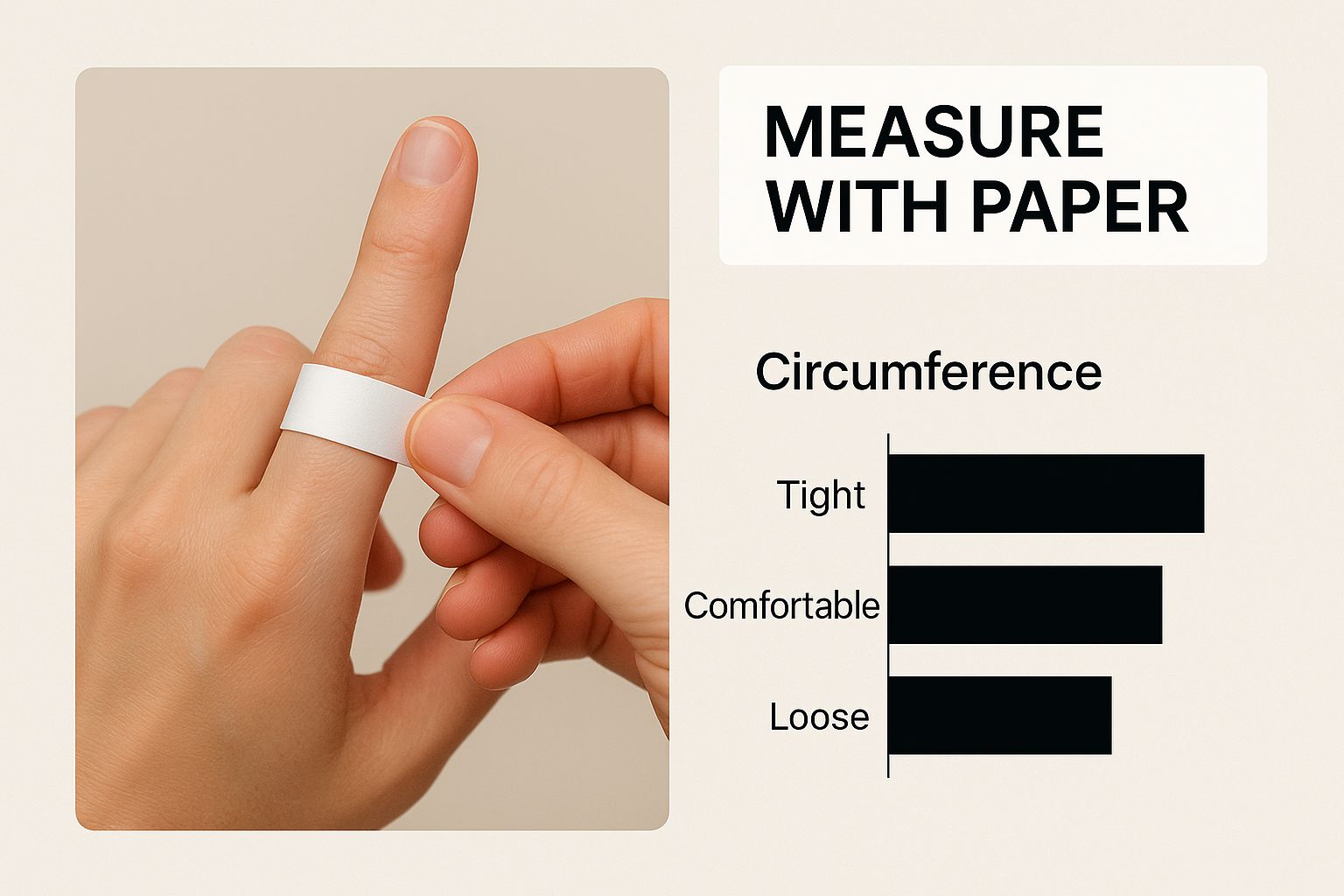
As you can see, the trick is to wrap the paper snugly around the base of your finger. This gives you a starting point for the measurement.
Here’s a pro tip: Make sure whatever you use—paper or string—can slide comfortably over your knuckle. I've seen it happen many times: the base measurement is perfect, but the ring gets stuck. If you can't get it past the knuckle, it won't fit.
For more detailed steps and a chart to print out, you can check out our comprehensive ring size guide. It has everything you need to convert your measurement into the right size.
The Classic String or Paper Strip Method
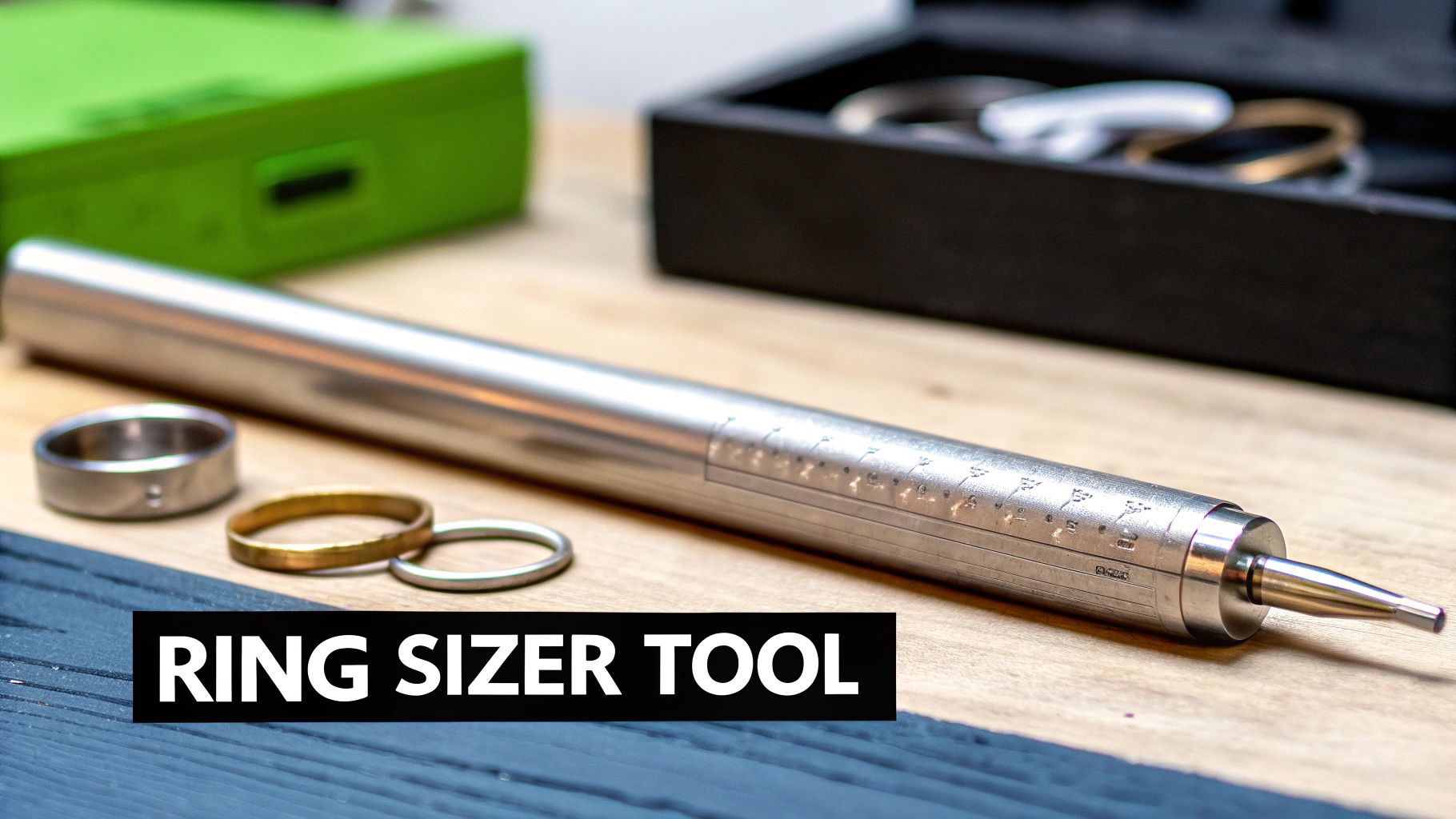
The string or paper strip method is a go-to for a reason—it’s a classic DIY approach that works surprisingly well if you're careful. This is your best bet when you don't have another ring to measure and need to get a size for a specific finger.
First things first, grab a piece of non-stretchy string, some dental floss, or a thin strip of paper. The key here is non-stretchy. I've seen people try this with yarn or a thin rubber band, and it always results in a size that’s way too small.
Wrap the string or paper snugly around the base of your finger, right where you want the ring to sit. You're aiming for a comfortable fit. It shouldn't be tight enough to leave an indent, but it also shouldn't be so loose that it slides around easily.
Nailing the Measurement
Once you’ve got it wrapped just right, take a fine-tip pen and mark the exact spot where the end overlaps the strip. This little mark is everything, so be precise! A thick, blurry line can easily throw your measurement off by a half or even a full size.
Now, unwrap the string or paper and lay it flat against a ruler. You'll want to measure the length from the end to the mark you made in millimeters (mm). This unit is the standard for almost all ring sizing charts. As a reference, a measurement of 54.4 mm usually translates to a US size 7.
Pro Tip: Your fingers change size throughout the day. They tend to swell a bit from heat and daily activities. For the most accurate reading, always measure your finger at the end of the day when it's likely at its largest. This little trick ensures your ring will still feel comfortable after a long day.
To turn your measurement into an official ring size, you'll need a conversion chart. You can explore our complete size guide to find the perfect match and see some visual examples that make the whole process stress-free.
Using an Existing Ring to Find Your Size

Do you already have a ring that fits perfectly? If so, you're in a great spot. This is probably the most reliable at-home method because it takes a lot of the guesswork out of the equation. You already know the ring works with your finger's fluctuations and knuckle size because, well, you wear it!
The most straightforward approach is to use a printable ring size chart. The key here is to print it at 100% scale. Don't let your printer "fit to page" or apply any other scaling, or the entire chart will be useless.
Once it's printed, just lay your ring over the circles on the chart. You're looking for the perfect match—the circle where the black outline is just visible inside your ring. The inner edge of your ring should line up exactly with the circle's edge.
What if I Don't Have a Printer?
No problem. A simple ruler and a little math will do the trick.
Lay your ring on a flat surface and grab a ruler with millimeter markings. You'll want to measure the internal diameter—that's the distance straight across the inside of the ring. It’s important to only measure the empty space and not include the metal of the band itself.
After you have that measurement in millimeters, a quick search for a ring size conversion chart online will tell you the corresponding size.
A Quick Word on Band Width: Here’s something a lot of people don’t realize: not all rings of the same size fit the same way. A wider band (think 6mm or more) covers more of your finger, which makes it feel much tighter than a delicate, thin band. If you're using a skinny ring as your guide to buy a wide-band ring, you'll almost certainly need to go up a half or even a full size.
Getting these little details right is what ensures a perfect fit. If you have more questions, we've probably answered them over in our Molenia Jewelry FAQ section.
Key Factors That Really Affect Your Ring's Fit
Finding your ring size isn't just a simple measurement you take once. Think of your fingers as being in constant flux—they actually change size throughout the day. A ring that slips on perfectly in the morning might feel surprisingly snug by evening.
Things like a hot day, a humid climate, or even a salty meal can make your fingers swell up. In the cold, they do the opposite and shrink a bit. That's why I always recommend measuring your finger a few times on the same day, maybe once in the morning and again in the evening, to get a true feel for your average size.
Why the Band's Width is a Game-Changer
One of the most common mistakes I see people make is forgetting about the ring's width. This detail is absolutely crucial and can completely change how a ring feels.
A thick, statement band—anything 6mm or wider—takes up a lot more real estate on your finger. Because it covers more skin, it creates more friction and feels much tighter than a thin, delicate band of the exact same size.
Expert Tip: If you're measuring your finger with a skinny string or a thin ring but are planning to buy a wide-band ring, you'll almost always want to go up by at least a half-size. This small adjustment makes a world of difference for comfort.
Don't Forget About Your Knuckle
Lastly, you have to get the ring over your knuckle. It’s a simple but vital part of the equation. If your knuckle is noticeably larger than the base of your finger where the ring will sit, you'll need to size up just enough to slide it on and off without a fight.
Being gentle when you put on and take off your rings is also key to their longevity. Our guide on jewelry care has some great tips for keeping your favorite pieces looking brand new.
Navigating International Ring Size Charts
Shopping for jewelry online means you can find incredible, unique pieces from designers all over the world. But it also introduces a common little hurdle: ring sizes aren't universal. A size 7 in the US is completely different from a size 7 in the UK or Japan, which can make you hesitate before clicking "buy."
The truth is, different parts of the world developed their own sizing standards over time. The UK and Australia, for instance, use a letter-based system (A, B, C...). Many European countries simply use the ring's inner circumference in millimeters. Then you have places like Japan and India, which have their own unique numerical scales. If you're curious, you can dive into the history of these different ring sizing standards on Wikipedia.
How to Convert Between Common Ring Sizes
The secret is to know your size in one system and then use a trustworthy chart to convert it. The main systems you’ll run into are:
- US/Canada: This is the familiar numerical scale, typically running from size 3 to 13, with half sizes included.
- UK/Australia: This system uses letters of the alphabet, from A to Z.
- European (ISO 8653): This size is simply the inner circumference of the ring measured in millimeters.
For example, a US size 7 has an inner circumference of 54.4 mm. That translates to roughly an N ½ in the UK/Australian system. Once you know that, you can shop from international jewelers with much more confidence.
Here’s a practical example: You've fallen for a beautiful vintage ring from a seller in Italy. They've listed it as an Italian size 14. Italian sizing is just the circumference minus 40 mm. So, a size 14 actually has a 54 mm circumference, which is almost a perfect match for a US size 7.
To take the guesswork out of it, a reliable conversion chart is your best friend. We've put together an easy-to-use chart to help you figure it all out. Take a look at our complete ring size guide with a conversion chart to find your perfect fit, no matter where your new favorite ring comes from.
Got Questions About Ring Sizing? Let's Talk.
Even after you've measured, you might still have some nagging questions. It’s completely normal. Let's walk through some of the most common things people ask to make sure you find a ring that feels like it was made just for you.
First off, people often ask which at-home method is the most accurate. Honestly, using a printable chart with a ring you already own and love is probably the most foolproof. That said, the paper strip method can be surprisingly precise if you're careful. The real secret isn't the method itself—it's how you do it. Paying close attention to the details, like measuring when your fingers are at their normal size and marking the paper exactly, makes all the difference.
What’s the Average Ring Size?
It can be useful to know the averages, especially if you're picking out a surprise gift. We looked at over 5,000 ring orders and found something interesting: about 50% of women's rings are between sizes 6 and 8, with size 7 popping up most often. For men, the sweet spot is usually between sizes 9 and 11, with size 10 being the most popular.
But remember, these are just statistics. Everyone is different, and nothing beats getting an actual measurement. If you're curious to learn more, you can check out these insights into average ring sizes on My Irish Jeweler. This data really just proves how much sizes can vary and why a personal fit is so important.
How Should a Ring Actually Fit?
Finding the perfect fit is all about striking a balance. You want your ring to be snug enough that you're not constantly worried it's going to fly off, but not so tight that it’s uncomfortable.
Here's a great rule of thumb I always share: The ring should go over your knuckle with a little bit of a push, but then sit comfortably at the base of your finger. You should be able to spin it, but it shouldn't feel loose.
That "snug but not strangling" feel is exactly what you're aiming for.
At Molenia Jewelry, we believe finding your perfect piece should be a joy, not a hassle. We’re here to help every step of the way. Come explore our collection of sustainable, contemporary jewelry and find something that speaks to you at Molenia Jewelry.