

How to Determine Ring Size for the Perfect Fit?
Finding a ring that feels like it was made just for you starts with one crucial step: knowing your exact size. Getting this right is the key to comfort and security. It makes sure your new piece of jewelry fits perfectly from day one.
Why Finding the Perfect Ring Fit Matters
Let's be honest, a ring is so much more than an accessory. It might be a symbol of love, a daily reminder of a special moment, or just a statement piece that makes you feel incredible. But if the fit is off, that beautiful ring can quickly become a pain—literally.
A ring that is too tight can be uncomfortable and hard to remove. A ring that is too loose can be a constant worry. You're always afraid it's going to slip off and vanish.
People often guess your size. This is a significant reason that beautiful rings stay in a drawer. People should wear and love them.

Beyond Just a Number
Knowing your ring size does more than just help you pick a ring; it gives you the confidence to shop anywhere, especially online. You can finally explore unique designs without that nagging fear of, "What if it doesn't fit?"
Getting the size right for Molenia Jewelry rings is crucial. This is true whether you are buying for yourself or planning to astonish someone special.
This guide is here to walk you through it. We’ll cover a few simple, reliable methods you can use right now with things you probably already have at home. Think of it as your personal cheat sheet for finding that perfect, feels-like-it-was-made-for-you fit.
Getting the size right from the start saves you time and money. It also helps you connect more with the piece. When a ring truly feels like it belongs on your finger, its meaning just grows.
Four Reliable Ways to Measure Your Ring Size at Home
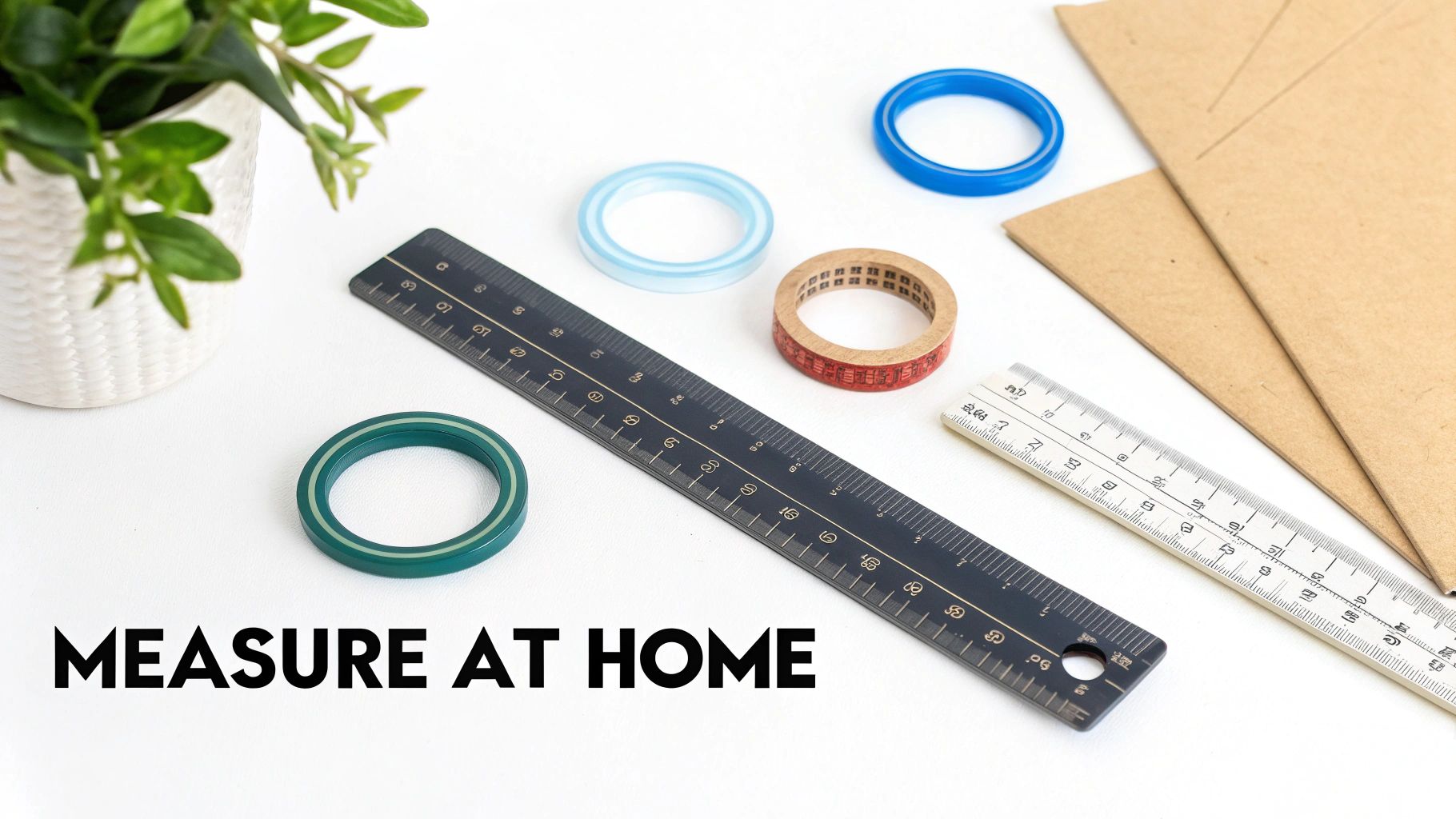
Ready to figure out your ring size without ever leaving the house? Let's get practical. Here are four proven methods to help you get a reliable measurement. You can use simple tools you likely have at home.
Method One: The Printable Ring Sizer
A printable ring sizer is one of the most accurate at-home methods, but only if you follow the printing instructions to the letter. These charts are helpful because they offer two options. One is a cut-out sizer to wrap around your finger. The other is a set of circles to match with a ring you already love.
Here’s the single most important step: make sure the sizer prints at 100% scale. Do not let your printer "fit to page" or use any other scaling option, as that will throw off the whole measurement. A good chart will include a little ruler or ask you to place a coin on it to double-check that the scale is perfect.
Once you’ve confirmed the scale, carefully cut out the sizer. Wrap it snugly around the base of your finger—the one you'll be wearing the ring on. You're looking for a fit that's tight enough not to fall off but loose enough to slide over your knuckle.
The number the arrow points to? That’s your ring size.
Method Two: The String or Dental Floss Trick
This classic technique is a great backup if you can't reach a printer. It works surprisingly well if you do it carefully. You just need a piece of non-stretchy string, dental floss, or even a thin strip of paper. Grab a pen and a ruler, and you're all set.
Start by wrapping the string around the base of your finger where the ring would normally sit. Getting the right tension is everything. It should be snug, but not uncomfortably tight. Think about how a perfect ring feels—it's secure without cutting off circulation.
With the string fitted just right, use a fine-tipped pen to mark the exact spot where it overlaps to form a full circle. Now, unwrap the string and lay it flat against a ruler that has millimeter markings. Measure the length from the end to your pen mark. That number, in millimeters, is your finger's circumference.
From there, you can match your measurement to a standard ring sizing chart to find your size. For example, a measurement of 54.5 mm usually translates to a US size 7.
Pro Tip: Don't forget about your knuckle! If it's noticeably larger than the base of your finger, measure both spots. You’ll need to pick a size that’s sufficiently large to slip over the knuckle but won’t spin around once it's on.
Method Three: Using a Ring You Already Own
If you have a ring that already fits the intended finger perfectly, you're in luck. This is a great shortcut because it takes all the guesswork out of finger swelling and knuckle size. You’re starting with a known winner.
You can use this ring in a couple of ways. The easiest is to place it over the circles on a printable ring sizer chart.
Keep trying until you find the circle that fits perfectly inside your ring. The black outline should be just visible, with no white space showing. The number for that circle is your size.
No printer? No problem. Grab a ruler and measure the ring’s internal diameter.
- Lay your ring on a flat surface.
- Place a ruler with millimeter markings straight across the center of the ring.
- Measure the distance from one inner edge to the opposite inner edge. Make sure you aren't including the metal of the band in your measurement!
Once you have the diameter in millimeters, a conversion chart will tell you the corresponding ring size. An internal diameter of 17.3 mm, for instance, is a US size 7. This method achieves high accuracy because it relies on a fit you already know works.
Method Four: Investing in a Reusable Sizer
For the best at-home results, a reusable ring sizer is a great tool. It is especially useful if you buy many rings. They are incredibly cheap, usually just a few dollars online. They also help you avoid common mistakes with DIY methods.
You'll generally find two types:
- The Sizing Belt: This is basically a small plastic zip-tie. You slide the end through a buckle to make a ring shape, slip it on, and pull it snug. An arrow points directly to your size.
- The Sizing Gauge Set: This looks like a key ring full of plastic or metal sample rings, each labeled with a size. You just try them on until you find the one that feels perfect.
These tools are essentially what a jeweler uses, just in a more accessible format. They give you total peace of mind, especially if you're shopping for something important like an engagement ring. Feeling the fit helps you find the perfect size. It also makes it easier to know if you need to go up or down a half-size for comfort.
Understanding International Ring Size Conversions
One of the best parts about shopping online is discovering unique jewelry from artists all over the world. But this amazing access comes with a small, but crucial, detail: ring sizes are not the same everywhere. A size 7 in the US is very different from a size 7 in Japan. This difference can make buying a ring from another country feel risky.
Getting a handle on these differences is the secret to shopping with confidence. It means that gorgeous ring you found from a small boutique in Paris or an artisan in Tokyo will actually fit when it arrives. Let's break down why these sizing systems are so different and how to easily translate between them.
Why Sizing Systems Differ Globally
At its core, the reason for all the different sizing standards comes down to how they're measured. Some countries base their system on a ring's inner diameter, while others use its inner circumference. A simple difference creates a lot of confusion.
Here’s a quick rundown of the major players:
- United States & Canada: These countries use a numerical scale (like Size 6, 7, 8) that’s based on the inner diameter of the ring.
- United Kingdom & Australia: Here, you will see an alphabetical system (L, M, N). This system relates to diameter but has its own unique order.
- Europe (ISO 8653): This system is probably the most straightforward. The size is just the inner circumference measured in millimeters. A size 54 means the inside of the ring is 54 mm around. Simple!
- Japan has its own numerical system. It starts at size 1 and increases by 1/3 mm for each size.
These regional quirks can be a real headache. The most common women's ring size in the US is about 6 to 6.5. In the UK, that same finger would likely be an L or M.
This is why so many global jewelers struggle with return rates as high as 15-20% from sizing mistakes alone. Thankfully, brands that offer clear conversion charts can slash that number to under 5%.
How To Use An International Conversion Chart
Think of a conversion chart as your universal translator for jewelry. The best tool for navigating global sizes is available. It lets you quickly and accurately change your size from one system to another.
The best way to use a chart is to first find your actual measurement using one of the at-home methods we discussed. Once you know the size of your finger in millimeters, you can find your perfect size in any country.
Let's say you used the string method and measured your finger's circumference at 54.5 mm. A quick look at the chart below shows you're a US size 7, a UK size N, and a Japanese size 14. Easy as that.
International Ring Size Conversion Chart
This table helps you compare ring sizes from common international standards. It includes sizes from the US/Canada, UK/Australia, Japan, and Europe (ISO 8653).
| US & Canada | UK & Australia | Japan | Inner Circumference (mm) | Inner Diameter (mm) |
|---|---|---|---|---|
| 5 | J ½ | 9 | 49.3 mm | 15.7 mm |
| 5.5 | K ½ | 10 | 50.6 mm | 16.1 mm |
| 6 | L ½ | 12 | 51.9 mm | 16.5 mm |
| 6.5 | M ½ | 13 | 53.1 mm | 16.9 mm |
| 7 | N ½ | 14 | 54.4 mm | 17.3 mm |
| 7.5 | O ½ | 15 | 55.7 mm | 17.7 mm |
| 8 | P ½ | 16 | 57.0 mm | 18.1 mm |
| 8.5 | Q ½ | 17 | 58.3 mm | 18.5 mm |
| 9 | R ½ | 18 | 59.5 mm | 19.0 mm |
If you want a longer list of conversions, check out our full Molenia Jewelry ring size guide. It has more details and helpful visuals. Armed with this knowledge, you can shop for rings anywhere in the world and be sure you're always getting the perfect fit.
Insider Tips from Jewelers for a Perfect Fit
Getting your ring size is one thing, but nailing that perfectly comfortable, “feels-like-it’s-not-even-there” fit? That’s an art. Over the years, we jewelers pick up on little details that a sizing tool alone can't tell you. This is the kind of know-how that turns a pretty good fit into a perfect one.
Think of your ring size as a dynamic number, not a static one. Your fingers change, and understanding why is the real secret to finding a ring you'll love wearing every single day.
The Impact of Ring Width and Style
One of the biggest mistakes people make is not accounting for the width of the band. A delicate, skinny band and a chunky, wide one in the same ring size will feel completely different on your finger. It's a classic rookie error.
A wider band covers more of your finger, which means it creates more friction and displaces more skin. This makes it feel much tighter. Here's a solid rule of thumb: for any ring wider than 6 mm, you should probably go up a half-size. If you are looking at a large band, like 8 mm or wider, you may need to go up a full size to feel comfortable.
On the flip side, a remarkably thin, dainty band has less surface contact, so it can feel a little looser. If you’re buying a delicate stacking ring, sticking to your true measured size is usually your best bet.
Understanding Standard Fit vs. Comfort Fit
Another detail that makes a world of difference is the shape of the inside of the ring. Rings generally come in two styles: standard fit or comfort fit.
- Standard Fit: This is the classic, old-school style where the inside of the ring is totally flat. It gives you maximum metal-on-skin contact. With wider bands, this style can sometimes feel like it's digging in a bit.
- Comfort Fit: Designers create these rings with a slightly rounded or domed interior. This smart design lowers the amount of the ring that touches your skin.
- It helps the ring glide over your knuckle more easily. It just feels better for all-day wear. Because they fit a bit looser, you often need to size down a quarter or even a half-size to get it just right.
Always check the product description to see if a ring is "standard" or "comfort" fit. If you use a standard sizer but buy a comfort-fit ring in that size, it’s going to feel way too loose. For something you'll wear forever, like a wedding band, that little sizing adjustment for a comfort fit is totally worth it.
When to Measure for the Most Accurate Reading
Believe it or not, your fingers shrink and swell throughout the day. Measuring at the wrong moment can easily throw your results off by a half-size or more. Timing is everything.
Your fingers are usually a bit smaller first thing in the morning and when you're cold. They swell up in warm weather, after a workout, or after a salty meal. It's just your body's natural response to temperature and water retention.
For the most accurate and reliable measurement, try to size your finger in the late afternoon or early evening. By then, your body temperature has stabilized, and your finger will be at its largest natural size for the day.
This simple trick helps you land on a size that will feel good through all those daily fluctuations. It's a small change that greatly improves comfort. This is especially true for important items like engagement and bridal jewelry, where a perfect fit matters most.
How to Secretly Find Someone's Ring Size
Planning an exciting proposal or picking out a special ring as a gift is one of the most thrilling things you can do. But let's be honest, one tiny detail can throw a wrench in the whole plan: figuring out their ring size. You want that magical moment when the ring slides on perfectly, right? This is your playbook for becoming a sizing ninja and keeping your secret safe.
We'll walk through a few clever strategies, from "borrowing" a ring they already have to bringing in a trusted friend for a covert mission. These tried-and-true methods will help you nail the size, making the big moment all about the thought and love behind the gift.
The Existing Ring Gambit
One of the most reliable ways to get the size right is to use a ring they already own and love. The trick here is to grab one they wear on the correct finger—for an engagement ring, that's the ring finger on their left hand. Here's a simplified version of the text:
"A quick tip: fingers on a person's dominant hand are usually a half-size bigger. So, a ring from their right hand might not fit well."
Once you’ve successfully "borrowed" the ring, you have a few options:
- Trace the inside. Place the ring on a piece of paper and carefully trace the inside circle with a sharp pencil. A good jeweler can often figure out the size from a precise tracing.
- Make an impression. Gently press the ring into a bar of soap. This creates a perfect mold that a jeweler can use to determine the size.
- Use a printable sizer. If you can sneak the ring away for a minute, you can place it over the circles on a printable sizing chart to find the corresponding size.
Whatever you do, just remember to put it back before they notice it's gone!
Enlist a Trusted Accomplice
Sometimes, the best move is to call for backup. A close friend, sibling, or even their mom can be an incredible ally in your secret mission. They can bring up ring sizes in a casual conversation way more naturally than you probably can.
For instance, a friend could suggest they go jewelry shopping "just for fun" or try on some rings while they're already out at a department store. The friend can then make a mental note of the size or even discreetly text you the info from the store.
Think about it: your partner is way less likely to get suspicious of a friend saying, "Ooh, let's try on these crazy rings!" than you suddenly asking about their finger size out of the blue. Just choose your accomplice wisely—someone who can actually keep a secret is a must.
Creative and Casual Conversation
If you're feeling bold, you can try to coax the information out of them yourself, but subtlety is key. You might admire someone else's ring and then casually ask your partner if they happen to know their size, "just in case" you ever felt like buying them one.
Another approach is to play the long game. Buy them an inexpensive, fun ring as a casual gift first. If it doesn't fit, their reaction and the process of exchanging it will give you the exact size you need for the main event.
And if you get it wrong, don't sweat it. You can find all the helpful information you need in our shipping and return policy to guide you through an exchange.
The jewelry world is also getting more high-tech. With 3D finger scanning and smartphone apps that let you measure at home with up to 98% accuracy, the game is changing. In fact, 70% of high-end jewelers now offer virtual try-ons, which has helped boost their conversion rates by 40% by making sizing so much easier for everyone.
Your Top Ring Sizing Questions, Answered
Even with all the right tools, it's totally normal to have a few questions pop up while you're trying to nail down the perfect ring size. We get it! To give you that final boost of confidence, we've put together answers to some of the most common questions we hear from customers.
What If I’m Stuck Between Two Sizes?
This happens all the time, so don't sweat it. Let's say your measurement puts you right between a size 6.5 and a 7. Our advice? Go with the larger size.
There are a couple of really practical reasons for this. First off, it's always much easier (and cheaper!) for a jeweler to make a ring a little smaller than it is to make it bigger. Sizing down is a straightforward process, but sizing up requires adding more precious metal, which gets more complex and costly.
Plus, our fingers are constantly changing. They swell up in the heat or after a salty meal and shrink when it's cold. That little bit of extra room in the larger size acts as a comfort buffer, so your ring won't feel like a vise grip on a hot summer day.
Can Any Ring Be Resized?
This is a big one, and the short answer is no, not all of them. While most simple bands made of gold, silver, or platinum are no problem for a good jeweler, some designs and materials just can't be altered.
Here are a few types of rings that are usually off-limits for resizing:
- Eternity Bands: These have stones going all the way around the band. Cutting into it would break that seamless, sparkling circle.
- Tension-Set Rings: The magic of these rings is how the metal's tension holds the stone. Resizing can mess with that delicate balance and compromise the setting.
- Alternative Metals: Super-tough metals like tungsten, titanium, cobalt, and ceramic are just too hard for standard jewelry tools to work with.
Before you get your heart set on a specific ring, always double-check the product description or ask if it can be resized. A quick question now can save you a lot of heartache later.
Are My Hands Really Different Sizes?
Yep, they most likely are! For most people, the fingers on their dominant hand (the one you write with) are about a half-size larger than on their non-dominant hand. It’s the result of a lifetime of opening jars, carrying groceries, and just generally using that hand more.
That's exactly why you need to measure the specific finger on the specific hand you plan to wear the ring on. A size that fits your right ring finger like a glove might feel a little loose on your left. Never assume they're the same!
At Molenia Jewelry, we believe every piece should tell a story and fit as if it were made just for you. Explore our collections and find a timeless keepsake designed to celebrate your most meaningful moments. Discover jewelry that says more at moleniajewelry.com.


